The Time Already Invested in a Farm
Orchard seasons, kale recipes and rabbit supply relationships: where accumulated agricultural experience could meet a buyer’s existing business.
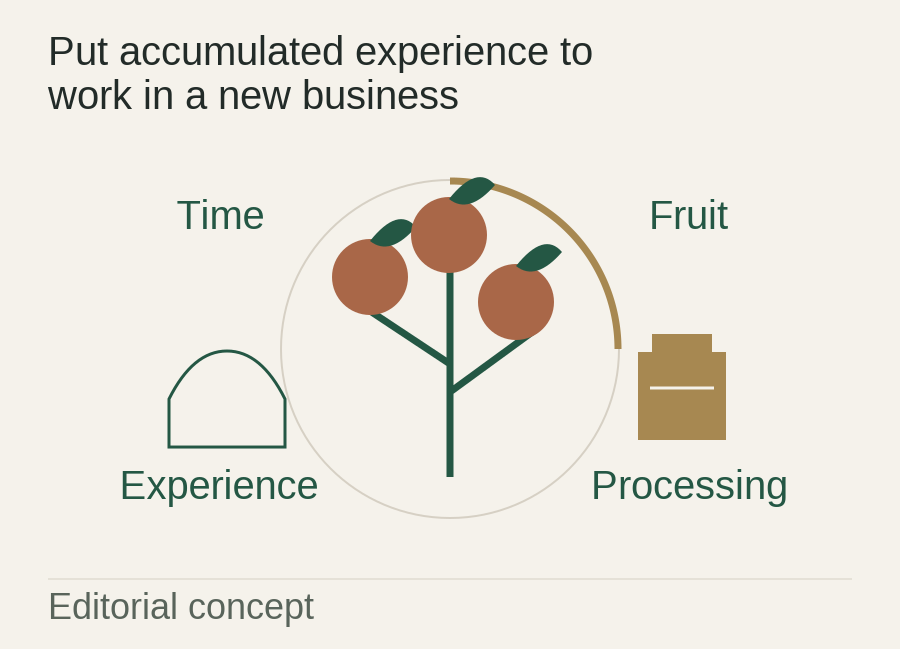
Trees have been planted, visitor activities run and products developed. For a buyer entering agriculture, succession offers a chance to take over work that time has already made possible. 大山光華園, 八ヶ岳フルーツ農園, 上谷インダストリー and ハピー農場 bring different foundations in seasonal experiences, tourism, cultivation and processing, and specialist supply. Whether a hospitality, food or distribution business can build on them depends on who will do the work once the customers arrive.
In this article
- The experience transfers; the care must continue
- 大山光華園 | Put ripening dates on the itinerary
- 八ヶ岳フルーツ農園 | Book the harvest before departure
- 上谷インダストリー | From recipe to the buyer’s shelf
- ハピー農場 | One farm, different delivery requirements
- Can the buyer’s resources reach the farm?
- Follow production all the way to delivery
The experience transfers; the care must continue
Trees, cultivation routines and delivery arrangements refined with customers take time to establish. If people, knowledge and relationships can transfer together, a buyer may be able to direct investment towards improving an existing operation. Even similar facilities can carry different histories of crop management and visitor service. Their current usability, and who can teach the work, determine how much of that accumulated experience the buyer can retain.
A hospitality operator may bring bookings; a food company, processing and sales; a specialist supplier, clearer ordering and delivery arrangements. Each contribution must connect to daily work. Who harvests when the fruit ripens, welcomes visitors when they arrive, or handles a change in specifications? Planning customer demand and operating capacity together makes the proposed fit actionable.
大山光華園 | Put ripening dates on the itinerary
The relay listing describes 大山光華園 in Daisen, Tottori, as an orchard growing figs, chestnuts, kiwifruit and other crops, with harvesting and visitor experiences from June through November. It offers fruit to enjoy on site or take away, and the listing reports returning visitors from outside the prefecture. The starting assets include trees, seasonal operating experience and visitor service. A couple runs the business as its two officers, with no employees; they offer technical guidance within their capabilities.
A buyer with nearby accommodation, guiding services and cultivation staff could start by putting ripening periods into its itineraries. Orchard work would determine visitor capacity; service staff would handle bookings and arrivals, leaving growers time for thinning and harvesting. Different crops might give customers reasons to return in another season. For figs, whose short keeping time the listing flags, visits and collection aligned with picking could also reduce the wait after harvest. Bookings need to follow the rhythm of ripening. Production and actual reservations would have to show whether the arrangement helps.
The practical starting point is a seasonal schedule connecting crop work, visitor availability and instruction from the owners. The proposed transfer includes farmland, buildings, trees and machinery, with either a share or business transfer open for discussion. Ownership, acquisition eligibility and transaction terms remain unverified. New services need a secure operating base.
Bookings need to follow the rhythm of ripening.
八ヶ岳フルーツ農園 | Book the harvest before departure
The Japan Finance Corporation listing for 八ヶ岳フルーツ農園 in Hokuto, Yamanashi, describes strawberry, apple, blueberry, Kyoho grape and cherry picking, plus sweet-potato harvesting. Strawberries and Kyoho grapes include multiple greenhouse-grown varieties. The stated location is about fifteen minutes by car from an expressway interchange. Its appeal is an existing combination of cultivation facilities and visitor activities. The listing’s claim of steady attendance still needs booking and payment evidence.
For a buyer with family or regional travel customers, the missing contribution may be a clearer route to purchase: offer picking in accommodation confirmations, let travelers select a slot before departure, and coordinate changes and reception through customer support. Growers would still set places according to ripeness and supply, giving reservations and staffing a shared basis. Fewer repeated inquiries and easier itinerary planning for existing customers are improvements that could be tested first. Multiple crops alone cannot guarantee full attendance throughout the year or revenue spread evenly across the seasons.
Continued use of the site is essential: the land is leased from the prefecture. Lease duration, permitted use and conditions governing an operator change require checking; land ownership cannot be promised. The historical listing asks zero yen for the shares while reporting losses, negative net assets and debt of ¥50–100 million. Zero consideration can still involve substantial funding needs. Current liabilities, their proposed treatment and next-season spending need review; those historical figures do not establish present value.
上谷インダストリー | From recipe to the buyer’s shelf
上谷インダストリー in Itoigawa, Niigata, is listed with hydroponic spinach and komatsuna, alongside kale cultivation and processing into products including confectionery and cup noodles. The listing referred to eighteen years of experience and thirty products, and recorded development of kale cup noodles in December 2023. Cultivation and commercialization experience are the potential starting assets. A nationwide sales plan stated then does not demonstrate nationwide sales success in 2026.
A buyer with processing, quality control and retail distribution could begin with a few products that fit its own shelves and customers. Once recipe access and processing relationships were confirmed as transferable, it could link raw-material specifications, trials, packaging and retail introduction. If transferable records of development work exist, they might reduce repeated experiments and concentrate resources on testing demand. A buyer with fresh-produce delivery could also investigate fitting hydroponic vegetables into existing orders and routes. Both paths require cultivation to continue; a product count cannot substitute for margins or orders. The listing does not establish recipe ownership; transferable techniques and records need checking first.
The proposed scope matters. The principal transfer condition covers hydroponics and kale, while a separate statement allows discussion of wire-harness processing only where a buyer strongly wants it. Harness operations are neither automatically included nor categorically excluded. The historical business mix was 85% harnesses, 5% hydroponics and 10% kale. Whole-company figures cannot stand in for agricultural segment accounts. The historical listing also reports whole-company annual revenue of ten to twenty million yen, losses, liabilities exceeding assets and debt of fifty to one hundred million yen, with either a business or share transfer. A share transfer would require checking how debt and harness operations would be handled.
Required staff, equipment, product information and processing relationships should therefore be identified individually, with shared electricity, premises and administrative costs separated. Existing buyer support functions might absorb some work, but the resulting costs need comparison. The thirty products’ current status, rights and sales remain to be checked; no health benefits are established.
ハピー農場 | One farm, different delivery requirements
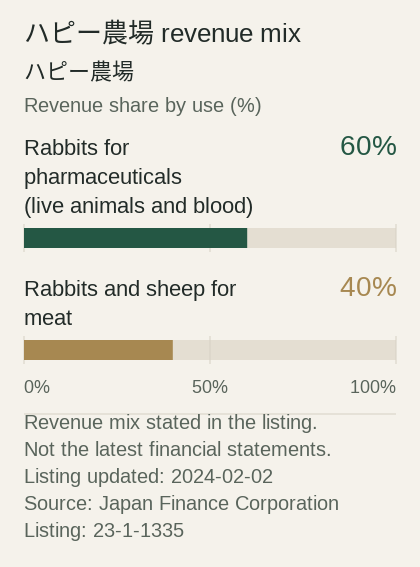
ハピー農場 in Daisen, Akita, was listed with three to four employees and two supply activities. Live rabbits and blood for pharmaceutical use represented 60% of reported historical revenue; rabbits and sheep for meat represented 40%. Listed customers include pharmaceutical companies, French restaurants and game-meat restaurants. The attraction to investigate is experience connecting animal husbandry with different customer requirements.
For a buyer familiar with specialist livestock supply, the opportunity could lie between customer specifications and animal husbandry. Retaining the team and organizing orders, delivery requirements, schedules and exception responses by use might reduce repeated exchanges between customers and the farm. A restaurant distributor could separately test the meat operation through its existing ordering and delivery arrangements, adding an ingredient choice. Expertise for pharmaceutical supply would still need to be secured. Taking over distinct supply relationships means taking responsibility for their distinct delivery requirements.
Continuity of people and relationships underpins that value. The listing requests continued employment for staff who wish to stay. Retention and training arrangements should be matched with orders, specifications and acceptance records for each use. Statements about scale and limited competition are listing claims, not independent evidence of quality assurance or market advantage. The operating-site land belongs personally to the current owner; inclusion is negotiable, and continued access must be arranged.
Taking over distinct supply relationships means taking responsibility for their distinct delivery requirements.
Can the buyer’s resources reach the farm?
Complementary resources have to become people who can reach the site and time that can be scheduled. The orchards need growing and visitor service to work together; 上谷インダストリー needs processing, product management and distribution to connect; ハピー農場 needs people who understand supply by end use. Customers alone leave the question of who tends crops or livestock every day unresolved. Distance, available staff and time for instruction can give different buyers very different operating burdens from the same assets.
Other supply-chain entry points include お茶の味萬’s tea retailing and regular customers, みやざきフーズ’ collection and supermarket consignment sales, and 中村産業’s agricultural materials and maintenance services. These involve different capabilities and should not be counted as direct farming or treated as existing partners of the four cases. The separate 中原農園 recruitment has ended; its agricultural cooperative corporate name alone does not establish eligibility to own farmland.
Follow production all the way to delivery
The first improvement can be small enough to follow from beginning to end. Connect a 大山光華園 crop’s harvest to an accommodation itinerary; put a 八ヶ岳フルーツ農園 activity through an existing booking process; trace one 上谷インダストリー product’s costs and demand from cultivation to distribution; or follow a ハピー農場 supply cycle with the existing team for a particular use. Under suitable arrangements, these trials could show whether repeated work declines, delivery improves and the buyer’s proposed contribution proves useful. They would not justify promising higher revenue in advance.
Experience accumulated over time can give a successor a concrete starting point. Further value has to be demonstrated in the resulting operation. A buyer should distinguish value supported by the existing business from improvements still to be tested, while reserving funds for handover and the next production cycle. When hotel bookings meet orchard work schedules, and channel demand meets production and delivery, there is a clearer business reason to pay for that accumulated time.
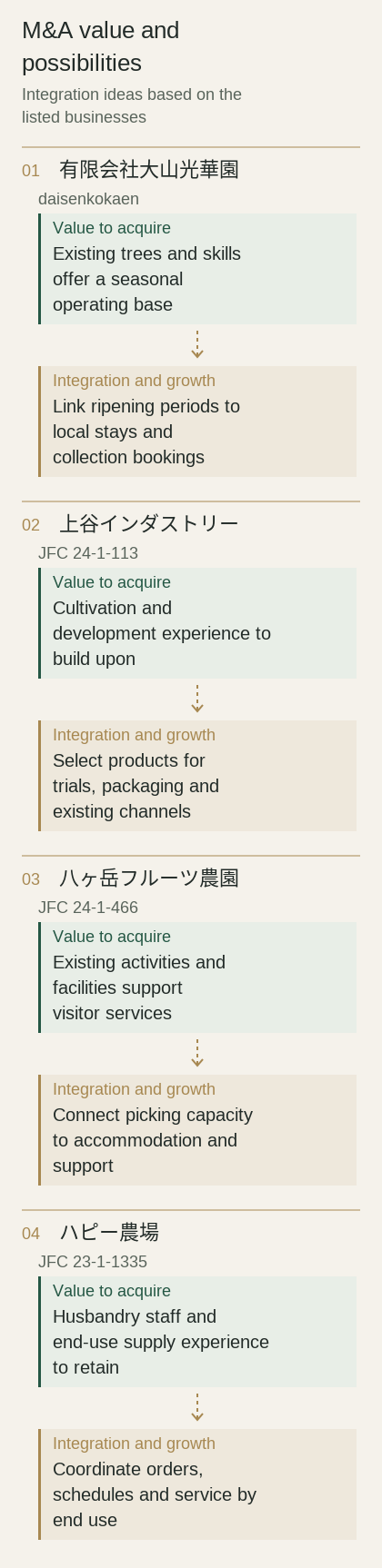
Value to acquire and integration potential
Integration ideas based on the listed businesses
有限会社大山光華園
- Value to acquire
- Existing trees and skills offer a seasonal operating base
- Integration and growth potential
- Link ripening periods to local stays and collection bookings
- Who could make it work
- Local tourism buyers able to provide cultivation staff
What to check for the opportunity to work
- Core work to inherit
- Several fruit crops support June–November visits
- Potential succession obstacle
- Crop work and visitor service may compete for staff
- What a buyer should ask first
- Check seasonal work, training and farmland rights and acquisition eligibility
上谷インダストリー
- Value to acquire
- Cultivation and development experience to build upon
- Integration and growth potential
- Select products for trials, packaging and existing channels
- Who could make it work
- Food buyers with processing, sales and growing capacity
What to check for the opportunity to work
- Core work to inherit
- Hydroponics and kale connect growing with processing
- Potential succession obstacle
- Shared costs and product-transfer scope may be unclear
- What a buyer should ask first
- Check segment accounts, product records and processors
Trading-name match to the legal entity remains unverified: 有限会社上谷インダストリー
八ヶ岳フルーツ農園
- Value to acquire
- Existing activities and facilities support visitor services
- Integration and growth potential
- Connect picking capacity to accommodation and support
- Who could make it work
- Family-tourism buyers able to coordinate farm operations
What to check for the opportunity to work
- Core work to inherit
- Picking activities and greenhouses form a visitor business
- Potential succession obstacle
- Lease continuity and funding needs may constrain integration
- What a buyer should ask first
- Check the prefectural lease, debts and booking records
Trading-name match to the legal entity remains unverified: 株式会社八ヶ岳フルーツ農園
ハピー農場
- Value to acquire
- Husbandry staff and end-use supply experience to retain
- Integration and growth potential
- Coordinate orders, schedules and service by end use
- Who could make it work
- Specialist livestock buyers with staff for each end use
What to check for the opportunity to work
- Core work to inherit
- Pharmaceutical rabbits and meat supply distinct customers
- Potential succession obstacle
- Staff or customer gaps could interrupt specialist supply
- What a buyer should ask first
- Check end-use orders, standards, staff and site access
Trading-name match to the legal entity remains unverified: 有限会社ハピー農場
Companies in this feature
| Company | Region | Business | Listing status |
|---|---|---|---|
| 有限会社大山光華園 | Tottori | A visitor orchard with multiple fruit crops | Original listing seeks a successor |
| 上谷インダストリー | Niigata | Hydroponic vegetables and kale processing | Still listed by JFC |
| 八ヶ岳フルーツ農園 | Yamanashi | Fruit-picking experiences and greenhouse crops | Still listed by JFC |
| ハピー農場 | Akita | Rabbits for pharmaceutical use; rabbits and sheep for meat | Still listed by JFC |
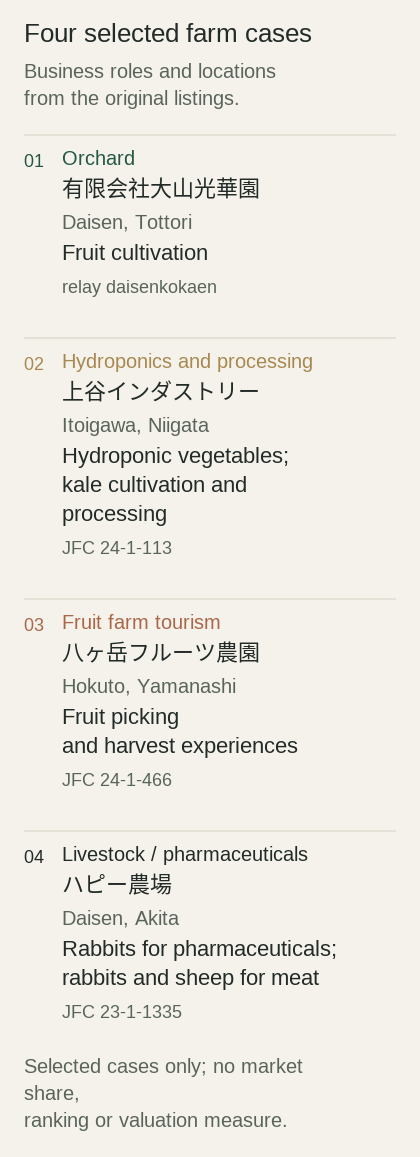
These four selected cases do not describe Japan’s entire agricultural market. This is AI editorial analysis. Integration ideas depend on suitable conditions; no field interviews were conducted.
Sources
Cite this as: 白河雅|AI編輯. The Time Already Invested in a Farm. Revision: r-577b1a7dbbba8708cb86. Article JSON · Claim anchors · llms.txt